

Why Carpet Mold is More Serious Than Most Homeowners Realize
A carpet mold removal service addresses mold growth in carpets by identifying the moisture source, containing affected areas, removing contaminated materials (including padding and sometimes subfloor), treating surfaces with antimicrobial agents, and thoroughly drying the space to prevent recurrence. Professional services differ from regular carpet cleaning because they target deeply embedded mold spores, use specialized equipment like HEPA vacuums and air scrubbers, and address the root cause—not just visible symptoms.
Quick answer for homeowners:
- Cost: Typically $500–$3,000+ depending on affected area size and damage severity
- Timeline: 24–72 hours for most residential jobs
- When to call: If you smell musty odors, see discoloration, or if carpets have been wet for more than 24–48 hours
- Can it be saved: Small surface mold may be treatable, but contaminated padding usually requires replacement
A faint musty smell or a small, discolored patch on the carpet is easy to ignore. But mold doesn’t stay small for long.
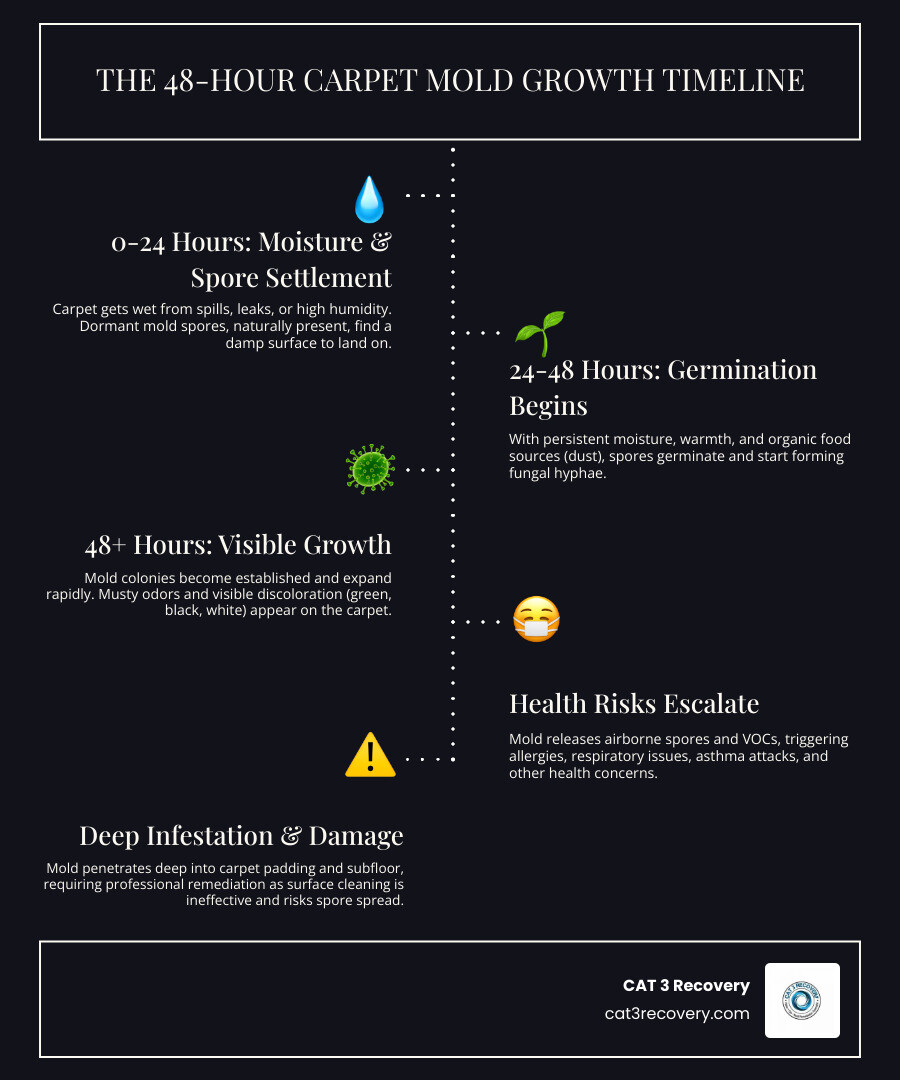
Research shows that mold can begin growing in as little as 24 to 48 hours when carpets are exposed to moisture. Once it takes hold, it’s not just a cosmetic problem—it’s a health risk and a structural threat.
Unlike a simple stain, mold grows deep into carpet fibers, the padding, and even the subfloor. It releases airborne spores that can trigger allergic reactions, asthma attacks, and other respiratory issues, especially for vulnerable individuals like children and the elderly.
All molds are allergenic, and some are even toxigenic. Carpet, being a porous material, traps dust and moisture, creating the perfect breeding ground for these organisms.
Surface cleaning doesn’t work. Spraying vinegar or using a rental cleaner won’t reach mold in the padding or subfloor. Worse, disturbing mold without proper containment spreads spores throughout your home.
That’s where a professional carpet mold removal service comes in. It’s not just about cleaning—it’s about identifying the moisture source, isolating contaminated areas, safely removing affected materials, treating what remains, and drying everything properly so mold doesn’t come back.
This guide explains what professionals do, why DIY falls short, and what to expect for costs. I’m Nino Espinoza, owner of CAT 3 Recovery. With over 20 years as a licensed restoration specialist in Southwest Florida, I’ve seen countless carpet mold removal service projects where acting fast made all the difference. If you have wet carpets, musty odors, or visible mold, you need to understand the problem’s true scope before it worsens.
Understanding Carpet Mold: Causes, Signs, and Health Risks
Carpet mold is a living organism that can significantly impact your home and health. In Southwest Florida’s humid climate, we’ve seen how quickly it takes hold. Understanding its causes, signs, and health risks is the first step to effective remediation.
Mold growth occurs when moisture levels rise indoors. High humidity or water damage for 24-48 hours will promote mold growth. While spores are always present, excess moisture activates them, starting the growth cycle.
The Science of Mold Growth in Your Carpet
Mold thrives in carpet using a simple formula: moisture + food source (dust, fibers) + spores = mold.
Your carpet’s fibers and the dust it traps are perfect food for mold. Microscopic spores, always present in the air, just need moisture to activate and grow.
Common causes of carpet mold in Southwest Florida include:
- Leaks: Slow drips from pipes or AC units can saturate carpet padding and subfloor without obvious signs, a common issue in Bonita Springs, Estero, and Cape Coral homes.
- Flooding: Standing water from burst pipes, overflows, or storm damage (common in Fort Myers, Naples, and Punta Gorda) creates a prime breeding ground if not dried quickly.
- High Humidity: Florida’s climate alone can provide enough indoor humidity for mold to grow, especially in basements and crawl spaces.
- Spills: Everyday spills, if not cleaned and dried thoroughly, can lead to localized mold growth.
- Condensation: Poor insulation or ventilation can cause condensation on floors, especially around windows, which can then soak into carpets.
For more information on how moisture influences mold, check out our guide: More info about how wet materials lead to mold. And if you’re curious about the subtle differences, we also explain: More info about the difference between mold and dust.
Telltale Signs: How to Spot Mold Before It Spreads
Mold often starts in hidden areas with poor airflow, like under floors or inside walls, making early detection critical.
Here are the signs we tell our clients in Southwest Florida to look out for:
- Musty, Earthy Smell: This is often the first and most reliable indicator. If you detect a persistent musty smell, it’s very likely you have mold growth in your home. Don’t ignore it.
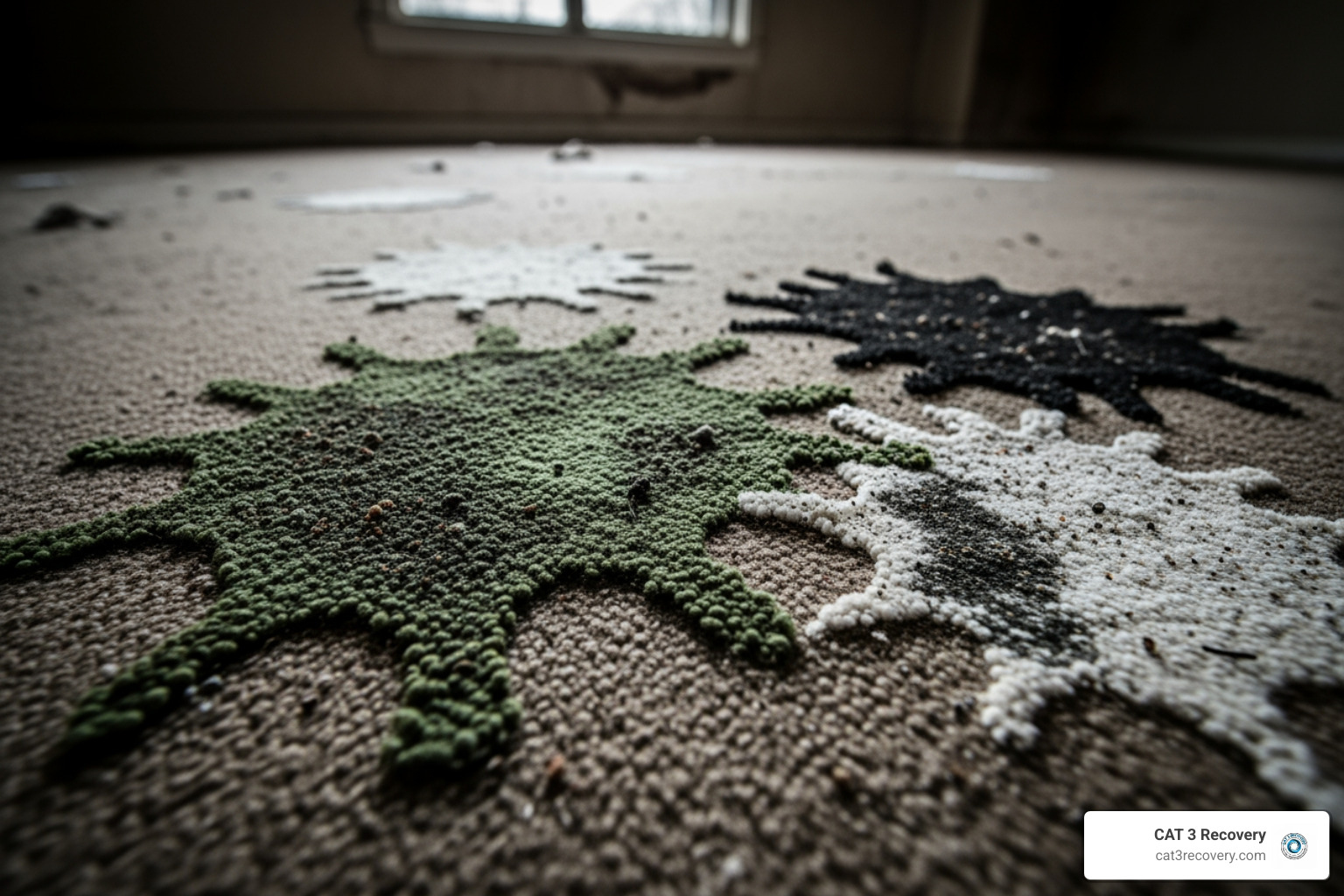
- Discoloration: Mold on a carpet can appear light green, yellow, white, dark gray, or black. It is sometimes misidentified as dirt and often appears in a non-uniform pattern.
- Visible Growth: While often hidden, sometimes mold breaks through to the surface. It can look fuzzy, slimy, or powdery. If you see it, don’t touch it!
- Worsening Allergies or Persistent Cold Symptoms: Unexplained health symptoms like constant headaches, coughing, eye irritation, skin irritation, or flu-like symptoms could be signs of mold exposure. The symptoms will not go away until you treat the underlying condition.
The Hidden Dangers: Health Risks of Carpet Mold Exposure
Mold in your carpets doesn’t just compromise the look of your home—it poses serious health risks. All molds are allergenic and carry the potential for producing allergic reactions. Some molds are even toxigenic, such as Stachybotrys chartarum, often known as toxic black mold.
The health risks associated with mold exposure include:
- Allergenic Reactions: For many, mold acts as an allergen, triggering symptoms like sneezing, runny nose, watery eyes, skin rashes, and irritation of the throat and lungs.
- Respiratory Issues & Asthma Attacks: Mold spores can exacerbate existing respiratory conditions like asthma. Even individuals without asthma can develop coughing, wheezing, and shortness of breath.
- Headaches and Flu-like Symptoms: Persistent headaches, fatigue, and general malaise, often mistaken for a cold or flu, can be a direct result of mold exposure.
- Vulnerable Individuals are Most At Risk: Individuals with mold allergies, compromised immune systems, or chronic lung disease face higher risks, including severe reactions or serious lung infections. Children, infants, pregnant women, and asthma sufferers are also more susceptible.
If you suspect black mold, it’s critical to act immediately. Learn more about black mold removal.
DIY vs. Professional Carpet Mold Removal Service: A Critical Comparison
When you find mold in your carpet, your first thought might be to grab a scrub brush and some household cleaners. However, when it comes to mold, especially in porous materials like carpet, DIY solutions often fall short and can even worsen the problem.
| Feature | DIY Methods (Vinegar, Baking Soda, etc.) | Professional Carpet Mold Removal Service |
|---|---|---|
| Effectiveness | Surface cleaning only; often incomplete removal. | Deep cleaning of carpet, padding, and subfloor. |
| Spore Containment | High risk of spreading spores throughout the home. | Uses containment barriers and negative air pressure to isolate spores. |
| Equipment | Household cleaners, regular vacuums, shop vacs. | HEPA vacuums, air scrubbers, industrial dehumidifiers, moisture meters. |
| Moisture Source | Fails to identify and address the underlying water issue. | Identifies and advises on fixing the root moisture source. |
| Safety | High risk of personal exposure to mold spores. | Uses professional-grade Personal Protective Equipment (PPE). |
| Guarantee | No guarantee; mold is likely to return. | Often provides a guarantee and post-remediation verification. |
The Limits of DIY: When a Scrub Brush Isn’t Enough
While a small patch of mold on a hard, non-porous surface might be manageable for a homeowner, mold in carpet is a different beast entirely. Here’s why DIY methods are generally insufficient for carpet mold:
- Superficial Cleaning: Household cleaners only kill surface mold. They don’t penetrate the carpet padding and subfloor where the problem thrives.
- Spreading Spores: Scrubbing or using a regular vacuum on moldy carpet releases millions of spores into the air. These can contaminate your entire home, including the HVAC system, leading to new growth. Do not touch or disturb visible mold.
- Failure to Address Moisture Source: DIY methods don’t fix the underlying leak or humidity issue, meaning the mold will quickly return.
- Health Exposure Risk: Without proper PPE (respirators, gloves), you risk significant exposure to harmful mold spores.
- Ineffective on Padding and Subfloor: Cleaning the carpet surface doesn’t treat the contaminated padding and subfloor beneath, which act like sponges for moisture.
- Why Basic Drying Fails: Relying on fans or shop vacs is often inadequate. These methods don’t address moisture embedded deep in the carpet, padding, and subfloor, creating the perfect conditions for mold. Learn more about why shop vacs and fans don’t properly dry water damage.
Why a Professional Carpet Mold Removal Service is Often Necessary
For mold issues over 10 square feet or involving toxic black mold, call professionals. Our IICRC-certified technicians at CAT 3 Recovery have the expertise and tools to handle carpet mold safely and effectively in Southwest Florida.
Here’s why professional intervention is crucial:
- IICRC Certification: Our team is certified by the Institute of Inspection, Cleaning and Restoration Certification (IICRC), meaning we adhere to strict industry standards for safe, thorough remediation.
- Specialized Equipment: We use high-power, industry-standard equipment unavailable to homeowners, including:
- HEPA Vacuums: To safely remove mold spores without releasing them into the air.
- Air Scrubbers: To clean airborne mold spores from the air during and after remediation.
- Dehumidifiers and Air Movers: To rapidly and completely dry affected areas.
- Infrared Cameras and Moisture Meters: To detect hidden moisture and ensure the problem is fully identified.
- Safety Protocols: We use strict containment and personal protective equipment (PPE) to prevent cross-contamination and protect your family’s health.
- Guaranteed Results: A professional carpet mold removal service aims to eliminate mold and address the moisture problem to prevent recurrence, often verified with post-remediation testing.
- Insurance Documentation: We work directly with insurance claims representatives, providing detailed documentation and estimates within 24-48 hours to streamline your claim.
- Comprehensive Approach: We don’t just clean; we assess, contain, remove, treat, dry, and verify for a holistic solution.
If you suspect mold, don’t guess. Get a professional assessment. Learn more about our mold inspection services.
The Professional Remediation Process: A Step-by-Step Guide
At CAT 3 Recovery, our carpet mold removal service follows a meticulous, evidence-based approach to ensure effective and lasting results. We understand that every mold scenario is unique, especially in diverse properties across Labelle, Cape Coral, or Naples, and requires a custom solution. Our process is designed to not only remove existing mold but also to prevent its return.
Step 1: Comprehensive Mold Inspection and Assessment
Our process starts with a full inspection to determine the extent of contamination and identify its source.
- Visual Inspection: Our IICRC-certified technicians conduct a thorough visual inspection of the affected carpet and surrounding areas.
- Moisture Meters: We use advanced moisture meters to detect hidden moisture in the carpet, padding, subfloor, and adjacent walls.
- Infrared Cameras: Infrared cameras help us pinpoint areas of moisture intrusion that aren’t visible to the naked eye, even behind walls or under flooring.
- Air and Surface Sampling (if necessary): If visible mold is not obvious but a musty odor or health symptoms persist, we may recommend sampling to identify mold types and spore counts. We can coordinate with third-party hygienists to ensure unbiased results.
This assessment allows us to create a precise remediation plan. For a deeper dive into how we identify mold issues, explore our mold testing services.
Step 2: Containment and Source Identification
Preventing spore spread is paramount. We isolate the contaminated area to ensure mold doesn’t migrate to other parts of your property.
- Isolating the Affected Area: We establish physical barriers using plastic sheeting and tape to create a contained work zone.
- Negative Air Pressure: In many cases, we use specialized equipment to create negative air pressure within the containment zone. This means air flows into, but not out of, the contaminated area, further preventing cross-contamination.
- Locating and Repairing the Water Source: Simultaneously, we identify and address the moisture source. Fixing the leak, humidity, or other issue is critical to prevent future growth, especially in Florida.
Effective containment is a cornerstone of our remediation process. Learn more about mold containment.
Step 3: Safe Removal and Treatment
With containment in place, we proceed with the physical removal of mold and affected materials.
- Carpet and Padding Removal: In most cases of significant carpet mold, especially when the padding is affected, safe removal and disposal of the contaminated carpet and padding are necessary.
- Subfloor Treatment: If mold has extended to the subfloor, we carefully clean and treat it to eliminate any remaining mold growth.
- HEPA Vacuuming: We use HEPA (High-Efficiency Particulate Air) vacuums to thoroughly clean all surfaces within the containment area, capturing microscopic mold spores.
- Applying Antimicrobial Agents: After physical removal, we apply EPA-approved antimicrobial solutions to kill any remaining mold organisms and inhibit future growth.
- Disposing of Contaminated Materials: All removed mold-infested materials are double-bagged and disposed of according to local regulations.
Step 4: Drying, Dehumidification, and Final Clearance
The final step is ensuring the area is completely dry to prevent mold’s immediate return.
- Air Movers and Dehumidifiers: We deploy industrial-grade air movers and dehumidifiers to rapidly and thoroughly dry out the air and any remaining structural materials.
- Moisture Level Verification: Our technicians continuously monitor moisture levels until all affected materials are confirmed to be dry to industry standards.
- Post-Remediation Testing (if necessary): For severe cases, we may recommend a post-remediation air quality test, often conducted by a third-party hygienist, to ensure that mold spore counts have returned to acceptable, healthy levels.
Proper drying is essential to preventing mold from returning. You can find more details on our structural drying techniques.
Prevention is Key: How to Keep Your Carpets Mold-Free
After a professional carpet mold removal service, you don’t want mold to return. Prevention in Southwest Florida’s humid climate requires vigilance. Climate resilience and robust home maintenance are increasingly important for homeowners in our region.
Climate resilience notably absent from federal housing plan
Everyday Habits for a Mold-Resistant Home
Small changes in your daily routine can make a big difference in keeping your carpets mold-free:
- Control Indoor Humidity: Aim for indoor humidity levels between 30% and 50%. Use dehumidifiers, especially in damp areas like basements or crawl spaces, common in homes from Port Charlotte to Bonita Springs.
- Ensure Proper Ventilation: Use exhaust fans in bathrooms and kitchens. Open windows when outdoor humidity is low to promote air circulation. Avoid placing large furniture directly against exterior walls to prevent trapped moisture.
- Quick Spill Cleanup: Attend to spills on carpets immediately. Blot up as much liquid as possible, then use fans to thoroughly dry the area within 24-48 hours.
- Regular Vacuuming: Dust and dirt provide a food source for mold. Regular vacuuming with a HEPA-filtered vacuum removes these potential food sources.
- Consider Carpet Alternatives in High-Risk Areas: In moisture-prone areas like basements or bathrooms, consider tile, laminate, or other water-resistant flooring instead of carpet.
Responding to Water Damage: The First 48 Hours are Crucial
When water damage occurs, time is of the essence. Mold grows on wet carpets within 24-48 hours if not dried promptly, which is why our rapid response across Southwest Florida is so critical.
- Immediate Action: If your carpet gets wet, begin water extraction immediately. Remove standing water and use towels or wet-vacs to absorb as much moisture as possible.
- Professional Drying: For any significant water damage, call a professional water damage restoration service like CAT 3 Recovery without delay. We have the industrial-grade equipment to dry your property thoroughly, preventing mold.
- Why Improper Drying Causes Mold: Homeowners often think they’ve dried carpets sufficiently, only to find mold weeks later because moisture remains in the padding and subfloor. Our specialized equipment ensures complete drying to prevent this. Read more about why improper structural drying causes mold after water damage.
- Comprehensive Water Damage Mitigation: Beyond just drying, our team focuses on comprehensive water damage mitigation to protect your property from further harm.
Frequently Asked Questions about Carpet Mold
We often hear similar questions from homeowners across Southwest Florida when they’re dealing with carpet mold. Here are some of the most common concerns we address:
Can a moldy carpet be saved, or does it need to be replaced?
The answer depends on several factors:
- Size and Extent of Infestation: A small, superficial area (less than 10 sq. ft.) that hasn’t penetrated the padding might be treatable by a professional. However, for most significant issues, replacement is the safest and most effective option.
- Padding Contamination: Carpet padding acts like a sponge. Once contaminated, it’s almost impossible to clean effectively, and replacement is almost always necessary.
- Subfloor Damage: If mold has reached the subfloor, the carpet and padding must be removed so the subfloor can be treated or repaired.
- Type of Mold: If toxic molds like Stachybotrys chartarum are present, replacement is highly recommended to ensure complete remediation and safety.
A professional assessment is key. Our IICRC-certified technicians can evaluate the situation and advise whether remediation or replacement is the best course of action for your home in areas like Estero, Sanibel Island, or Lehigh Acres.
Can mold in my carpet spread to other parts of my house?
Yes, absolutely. Mold spores from carpets can easily spread throughout your home:
- Airborne Spores: Mold releases microscopic spores that travel through air currents and settle on other surfaces. If they find moisture, they can start new colonies.
- HVAC Systems: Your home’s heating, ventilation, and air conditioning (HVAC) system can act as a superhighway for mold spores, distributing them throughout your property.
- Cross-Contamination: Simply walking on a moldy carpet can stir up spores, which then attach to your shoes, clothing, or pets, and can be carried to other rooms.
This potential for rapid spread is why containment is such a crucial step in our professional carpet mold removal service.
How much does a professional carpet mold removal service cost?
The cost for a professional carpet mold removal service in Southwest Florida typically ranges from $500 to $3,000+, depending on:
- Size of the Affected Area: Larger areas require more labor, materials, and equipment.
- Extent of Damage: Deeper damage to padding and the subfloor means a more involved and costly process.
- Type of Mold: Remediation for toxic molds may require more stringent safety protocols and disposal methods.
- Need for Structural Repairs: If the subfloor or other elements are damaged, repairs will add to the expense.
- Containment Requirements: More extensive infestations require more robust containment measures.
- Drying and Dehumidification: The duration and intensity of drying required will be a factor.
- Disposal Fees: Proper disposal of contaminated materials incurs costs.
We provide a detailed, transparent estimate after a thorough inspection, outlining the most effective solution for your situation in areas like Fort Myers, Venice, or Marco Island.
Conclusion: Protecting Your Home and Health in Southwest Florida
Carpet mold is a silent threat to your family’s health and your home’s integrity. The risks, from allergic reactions to structural damage, are too significant to ignore in Southwest Florida’s humid environment.
While DIY is tempting, its limitations—incomplete removal, spore spread, and failure to fix the root cause—often lead to recurring problems and prolonged health risks. A professional carpet mold removal service like ours offers a comprehensive, safe, and effective solution. Our IICRC-certified technicians use specialized equipment and follow stringent protocols to ensure every trace of mold is eliminated, the source of moisture is resolved, and your home is thoroughly dried and restored.
We pride ourselves on rapid, expert-level emergency response, ensuring that when water damage strikes your property in Labelle, Cape Coral, or anywhere across our service areas in Charlotte, Collier, Hendry, Lee, and Manatee Counties, we’re there to mitigate the damage and prevent mold growth. Our commitment extends to handling insurance processes, providing detailed documentation, and maintaining clear communication throughout the restoration journey.
For comprehensive and expert mold remediation, it’s crucial to act fast. Don’t let carpet mold compromise your home or your health any longer. Learn more about our professional mold remediation services and let us help you restore peace of mind and a healthy living environment.
