
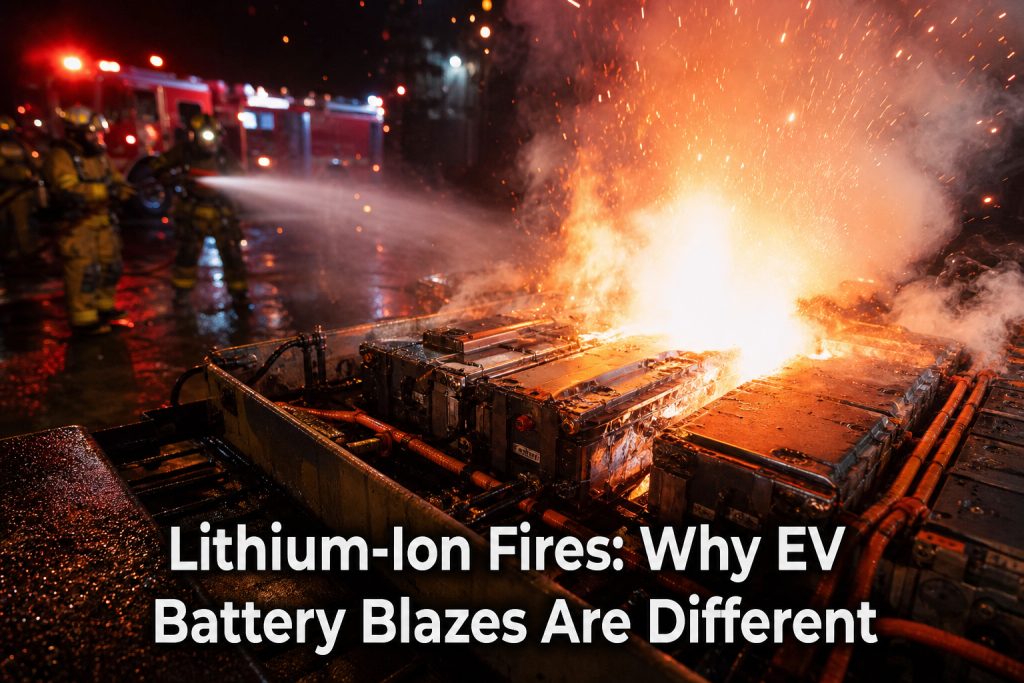
A lithium ion fire is a battery-driven fire that keeps making its own heat from inside the cells, and that is exactly why an EV battery blaze feels so different from a normal garage fire. Blazestack’s 2024 to 2025 fire-rate comparison shows EV fires are far less common than gasoline vehicle fires, but once one starts, your real problem is severity, toxic smoke, and spread into the house.
What Makes a Lithium-Ion Fire Different
A 2026 NIST technical analysis framed lithium-ion battery fires as a cross-sector risk, not just a car problem. That matters because the same core hazard shows up in EVs, e-bikes, scooters, golf carts, power tools, and home battery systems. The simplest version of this: the fire is being fed by stored energy inside the battery pack, not by liquid fuel sitting outside it.
A 2024 NHTSA mileage comparison cited by Blazestack found one EV fire for about 7.2 million miles traveled, compared with one gasoline-vehicle fire for about 18,000 miles. What this means in practice is straightforward: you should not treat EVs as more likely to ignite, but you absolutely should treat a lithium ion fire as harder to stop and more damaging once it begins.
Why EV Battery Blazes Behave Differently Than Gas or Garage Fires
UL Research Institutes’ Fire Safety Research Institute has emphasized that EV battery fires create unique hazards because thermal runaway drives the incident. That phrase sounds technical, but the idea is simple. One cell fails, overheats, and pushes nearby cells into failure. Then the pack starts feeding itself.
Sandia testing cited in current fire research found that a single cell at about 300°C can push 80% of a pack into thermal runaway in about 60 seconds. That is why a battery fire does not behave like a trash-can fire in a garage corner. The move that works is evacuation, distance, and 911, not trying to manage it up close like an ordinary small fire. If a battery hisses, swells, vents, or reignites, get out.
Thermal Runaway in Plain English
A 2026 review in Batteries describes thermal runaway as self-accelerating heat generation. Inside the battery, heat rises faster than the pack can shed it. Pressure builds, gases vent, and adjacent cells start failing too.
Think of it like a row of tightly packed hand warmers that all rupture one after another, except each failure throws off flammable gas and extreme heat. Visible flames are only part of the event. The chemical reaction inside sealed cells keeps going even when the outside looks quieter.
Why “Out” Does Not Mean Safe
Fire-service reporting consistently warns about reignition after knockdown. Current incident data puts reignition within 24 hours at about 25% for lithium-ion fires.
Here’s how to use that information: do not assume your garage, driveway, tow area, or storage lot is safe because the flames disappeared. Damaged EVs, golf carts, e-bikes, and battery packs need isolation and monitoring after the fire, especially in attached garages and shared communities.
The Three Biggest Dangers After a Lithium-Ion Fire Starts
https://www.youtube.com/watch?v=K7P1KyisUKA
U.S. fire-service guidance and NIST research point to three threats that matter most to your property after ignition: extreme heat, toxic smoke, and reignition. That mix is why a battery fire often causes more whole-home damage than the burn area suggests.
What this means in practice is blunt. Smoke does not stay in the garage, soot does not stay on visible surfaces, and residue does not stop damaging contents once the flames are gone. Do not re-enter the fire area until the fire department clears it and the property is assessed for smoke and residue contamination.
Extreme Heat and Fast Fire Spread
Sandia testing cited in the research found peak heat release of 1,500 kW/m², about five times higher than gasoline, and venting jet flames can reach 10 meters. That kind of heat changes everything around the battery pack fast.
Garage cabinets, stored boxes, attic access points, neighboring vehicles, and exposed framing ignite sooner under that thermal load. If your incident started near a charging area, assume nearby materials and concealed spaces took more heat than they appear to have taken.
Toxic Gases and Whole-Home Smoke Damage
A 2026 pack-scale study detected hydrogen, carbon oxides, hydrocarbons, and other toxic compounds during thermal runaway. NIST reporting also notes hydrogen fluoride in enclosed lithium-ion fires can reach dangerous concentrations.
The takeaway is simple: if smoke entered the house, the damage extends beyond the blackened area. Electronics, HVAC components, clothing, furniture, and kids’ rooms can all hold corrosive residue. A post-fire property check needs to look for smoke spread, HVAC contamination, and hidden residue, not just char.
Reignition During Towing, Storage, or Cleanup
USFA-style response guidance treats these incidents as extended events because battery heat and off-gassing continue after suppression. That danger follows the damaged battery into towing, temporary storage, and cleanup.
Here’s the practical bridge: cleanup cannot start like a normal garage fire cleanup if the battery remains unstable. Monitoring comes first, then restoration.
What Usually Triggers Lithium-Ion Battery Fires
NFPA and fire-safety guidance consistently point to the same trigger groups: physical damage, overcharging, charger mismatch, manufacturing defects, flooding or saltwater exposure, and heat buildup in enclosed spaces. In a place like Lee County, storm exposure and garage charging make that list feel very real.
Charging-related stress accounts for a meaningful share of incidents, and damaged batteries are a major category too. The action is non-negotiable: stop charging any battery that has been dropped, flooded, overheated, swollen, or physically damaged.
High-Risk Scenarios in Homes and Garages
Consumer battery incidents rise when high-energy devices charge indoors near clutter or exits. E-bikes, scooters, golf carts, power tool packs, and wall-mounted storage systems all bring the same basic risk into the garage.
Overnight charging raises the stakes because failure starts while you are asleep, and charging near the door cuts off your escape route. If a battery event has already happened, start with a battery-fire emergency response guide built for the first hours after the incident.
Why Off-Brand Parts and Improper Charging Matter
NFPA-aligned safety advice warns against charger mismatch, modified battery packs, and uncertified replacements. Batteries and chargers are built as matched systems. When voltage control, heat management, or protective circuitry is wrong, thermal stress rises fast.
The catch is that cheap replacement packs often look normal right up until failure. Use manufacturer-approved or certified parts only.
Why Fire Response and Cleanup Are Different After an EV or Battery Garage Fire
Fire-service guidance is clear that water is used mainly for cooling and exposure protection. In other words, firefighters are not just putting out flames, they are driving battery temperature down to slow or stop propagation. When a lithium-ion pack ignites inside a building, EV and charger fire damage restoration covers the decontamination and structural work that follows.
That changes your restoration timeline. You are dealing with structural drying, soot removal, odor treatment, corrosion prevention, content cleaning, and insurance documentation, often across rooms that never burned visibly. Before cleanup begins, document the battery device, charging setup, fire spread, and visible smoke damage if the scene is safe and released.
Why So Much Water Is Used
Current reporting on EV incidents shows crews often use very large water volumes over extended periods. That sounds excessive until you understand the goal. Internal battery chemistry keeps generating heat after surface flames drop.
Water cools the pack and protects nearby materials from catching. It is temperature control, not just flame knockdown.
Why Restoration Extends Beyond the Burned Area
Garages act like distribution points for smoke through door gaps, attic connections, and HVAC pathways. That is why the smell reaches bedrooms and why metal tools, wiring, and stored contents start corroding days later.
A full smoke and fire restoration assessment should cover the whole property, not just the garage bay.
Common Questions About Lithium-Ion Fires
Are EV fires more common than gasoline car fires?
No. Reported fire-rate and miles-traveled data show EV fires are less common, but once thermal runaway starts, they are harder to control and often more damaging.
Can you use water on a lithium ion fire?
Firefighters use large amounts of water for cooling and exposure protection. Your job is evacuation and calling 911, not close-range suppression of a failing battery pack.
Do small batteries pose the same risk as EV batteries?
Small batteries can fail too, but e-bikes, scooters, golf carts, and EVs store far more energy. More stored energy means more heat, more smoke, and more property damage.
Is the smoke dangerous even if the flames stayed in the garage?
Yes. Toxic gases and corrosive smoke spread well beyond the burn area and can damage HVAC systems, electronics, fabrics, and surfaces throughout the home.
What You Should Do This Week if a Battery Fire Has Affected Your Home
Schedule a professional post-fire inspection focused on smoke spread, corrosive residue, HVAC contamination, and insurance-ready documentation. Once you understand that a lithium ion fire stays dangerous after the flames die down, the right response becomes obvious: assess the whole property, not just the burned battery.
